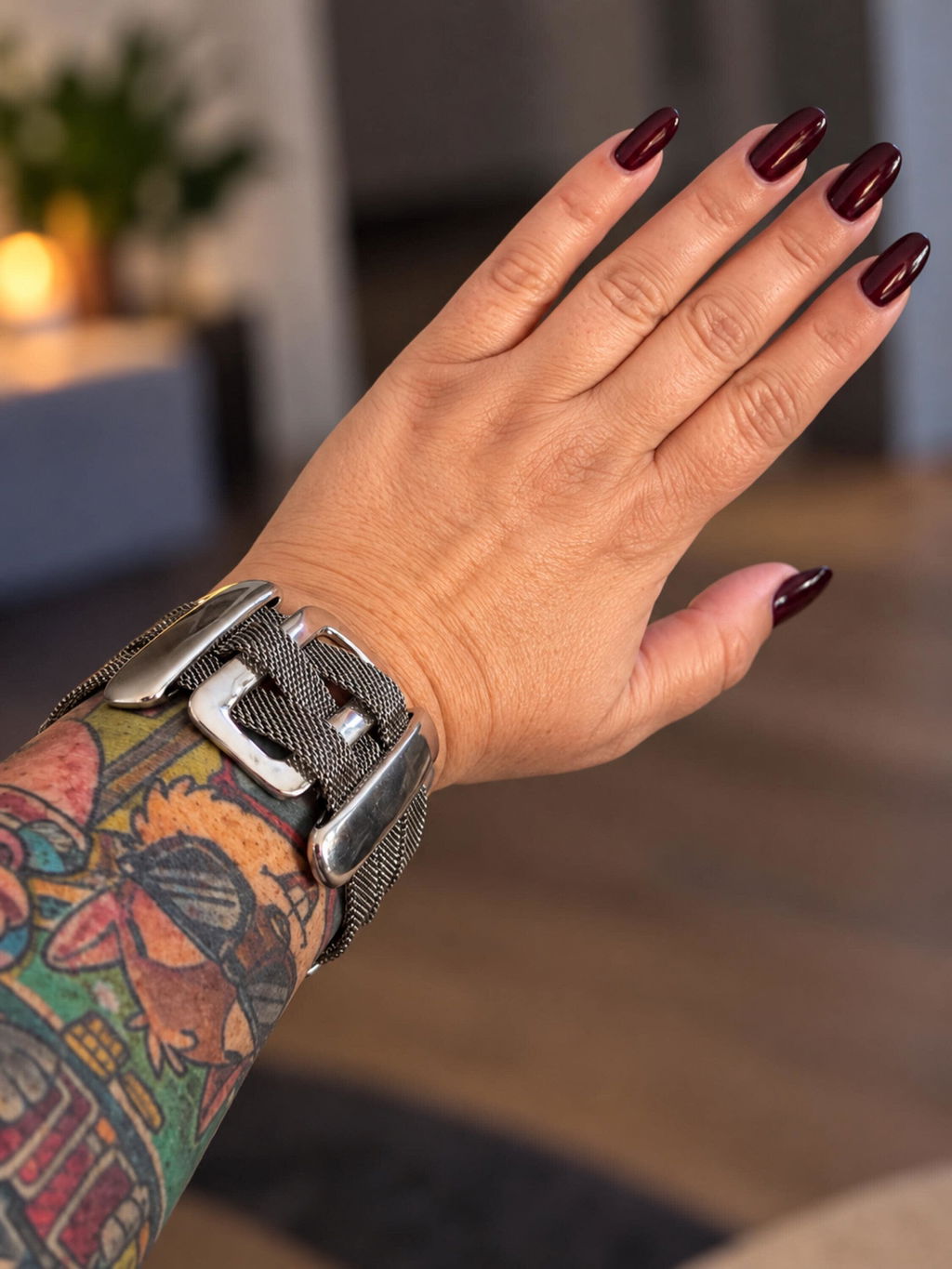
Bangle Bracelet vs Cuff Bracelet: What's the Real Difference?
A bangle bracelet is a rigid bracelet that forms a complete loop when worn. A traditional cuff bracelet is rigid or semi-rigid and has an open gap, allowing it to go onto the wrist from the side rather than over the hand.
The main difference is construction, not width, material, or formality. Hinged bangles and leather cuffs create exceptions to the simplest definitions, so check how a bracelet opens and fits rather than relying only on its name.
Bangle vs Cuff Bracelet: Differences at a Glance

| Feature | Bangle bracelet | Traditional open cuff bracelet |
|---|---|---|
| Shape when worn | Complete, rigid loop | Open-ended band with a gap |
| How it goes on | Slides over the hand or opens at a hinge and clasp | Goes onto the wrist through the gap |
| Closure | None on a slip-on design; a fastening on an opening design | Usually no clasp |
| Fit | Slip-on styles usually need room to pass over the hand | Can fit closer to the wrist without passing over the hand |
| Adjustment | Usually fixed-size unless specifically designed otherwise | Some designs allow limited adjustment; others do not |
| Width and material | Can be narrow or wide and made from various rigid materials | Can be narrow or wide; commonly metal |
What Defines a Bangle or a Cuff?
Bangles form a complete loop
A slip-on bangle has no opening mechanism and must pass over the widest part of the hand. A hinged bangle opens so it can be placed directly around the wrist, then fastens into a complete loop. Both are bangles, even though they go on differently.
Bangles can be round or oval, thin or broad, and made from metal, wood, resin, or other rigid materials. Neither a circular shape nor a metallic finish is required.
Traditional cuffs have an open gap
A traditional metal cuff has two ends separated by a gap. Its shape holds around the wrist without completing a closed ring, and an oval profile can help it sit close to the wrist.
Width does not define a cuff. For example, the Hammered Silver Stack Cuff is described as 7 mm wide, illustrating that cuffs can also be narrow.
Leather cuffs and overlapping names need a closer look
A leather cuff usually refers to a broad leather band, which may close with snaps, a buckle, or another fastening. It does not necessarily have the permanent opening of a traditional metal cuff.
Terms such as "cuff bangle" and "open bangle" also overlap in jewelry descriptions. The most useful distinction is whether the piece forms a complete loop when worn, retains an open gap, or is a flexible band with a closure.
How Sizing and Fit Differ
Size a slip-on bangle for your hand
For a slip-on bangle, wrist circumference alone is not enough: the bracelet must also pass over your hand. Follow the maker's hand-measurement instructions and compare them with the stated internal dimensions. Do not confuse inside diameter, inside circumference, and wrist size.
A hinged bangle does not need to pass over the hand, so it may fit more closely. Check its internal dimensions and leave enough clearance for comfortable wrist movement.
Size an open cuff for your wrist and its gap
Cuff fit depends on its internal dimensions, opening width, and shape. Measure your wrist where the bracelet will sit, then follow the maker's sizing guidance. A suitable cuff should not pinch, restrict movement, or slip off during ordinary movement.
For a traditional open cuff, ease the gap over the narrow side of the wrist and rotate the bracelet into position. Do not force it on or repeatedly pull the ends apart. An open design is not automatically adjustable; repeated bending can deform or damage a bracelet.
If you need help taking a wrist measurement, this bracelet sizing guide explains the measurement process. Hand clearance and cuff-gap fit still require the specific bracelet's dimensions.
Which Construction Suits Your Needs?
Choose by fit and handling rather than assuming one style is always more comfortable or secure. A correctly sized cuff may move less than a loose slip-on bangle, but weight, profile, and dimensions affect both.
- For a bracelet without a clasp, consider a slip-on bangle or an open cuff, provided you can put it on comfortably.
- If passing jewelry over your hand is difficult, consider an open cuff or a hinged bangle with a manageable fastening.
- For stacking, compare widths, weights, and clearance. Both styles can be stacked, but contact between pieces can cause scratches and noise.
- For desk work or fitted sleeves, check the bracelet's height and movement. Either style can catch on fabric or contact a work surface.
Neither style is inherently formal, casual, or limited to a particular wrist size. The practical difference remains the closed loop versus the open gap, with material and fastening determining any exceptions.
Frequently Asked Questions
Are bangles and cuffs both bracelets?
Yes. Bracelet is the broader term for jewelry worn around the wrist. Bangles and cuffs are bracelet styles distinguished mainly by their construction.
Can a bangle bracelet have a clasp?
Yes. Hinged or opening bangles can use a clasp or another fastening. They form a complete rigid loop when closed.
Are all cuff bracelets adjustable?
No. Some cuffs allow limited adjustment, while others have a fixed shape or a mechanism that should not be bent. Follow the maker's instructions rather than assuming the gap can be widened.
Is a wide bracelet always a cuff?
No. Bangles can be wide, and open cuffs can be narrow. Leather jewelry also uses the term cuff for broad bands that may fasten closed.